Personal Connection
Why I Chose This Topic
I chose Archbishop Tutu because he has a personal connection to my family in Cape Town. I was born in South Africa before my family moved to Ireland, and my mother attended St Cyprian's School in Cape Town, which is an Anglican girls' private school very close to the city centre.
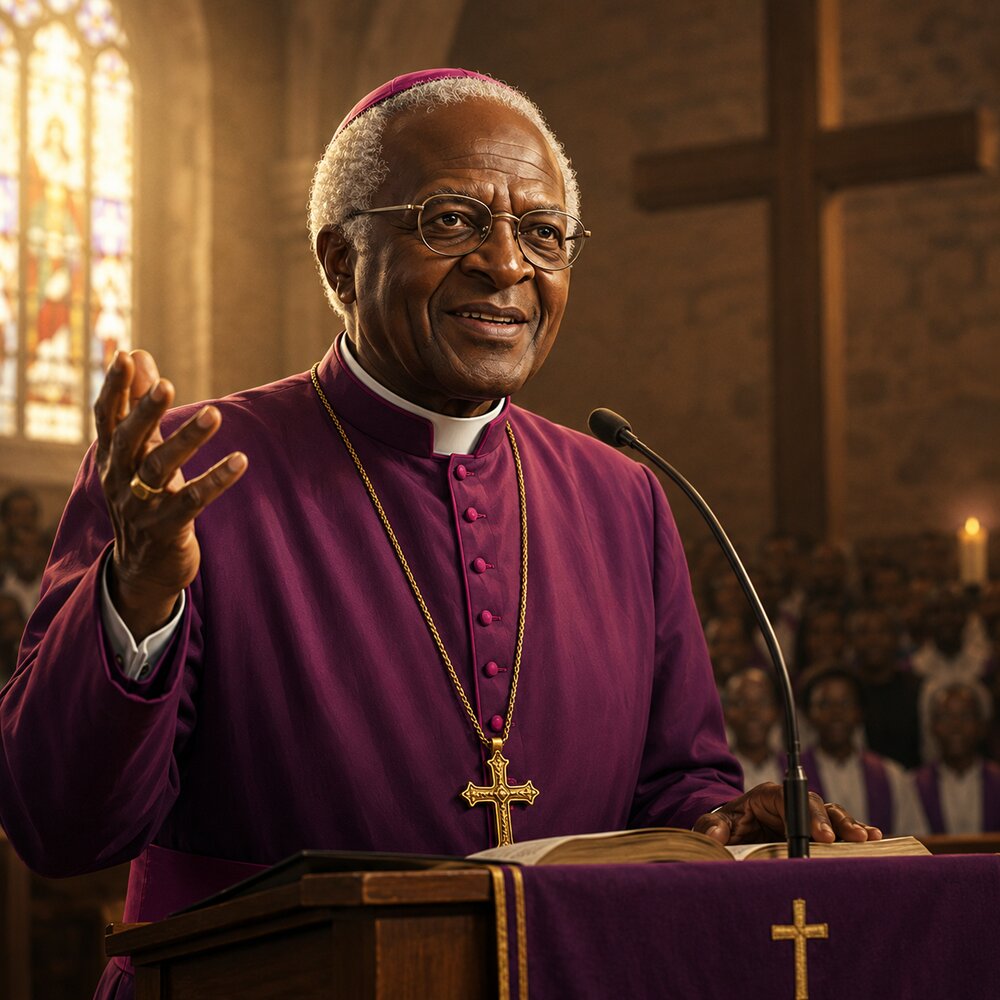
Because Archbishop Tutu was the Anglican Archbishop of Cape Town from 1986 to 1996, he was very involved with the school community. He was known for his warmth and engaging with students both in playful moments and moments of deep conversation. Tutu described the school as having achieved a "delicate balance" of excellence without elitism.
My Mom met him on many occasions while she was growing up. From the stories she told, he seemed like a very charismatic, lovable yet powerful, morally strong character that it made him feel like a real person to me, not just a name in a textbook.
What made me want to pick him for the CBA, though, was realising how much of his story is still visible if you walk through Cape Town today. His cathedral, St George's, is a five-minute walk from my Mom's old school.
In fact, the celebration of the school established in 1871, is held there every year too where the entire school marches through Cape Town down to St Georges Cathedral to a Church Service in Celebration of the school's birthday. People line the avenue to see the procession.
The City Hall balcony where Nelson Mandela gave his first speech as a free man on 11 February 1990 is in the same square.
Bishopscourt, where Tutu lived and where Mandela actually spent his very first night out of prison, is a short drive away. So I'm not just researching a famous person - I'm researching a person whose life is mapped onto a city my family knows.
As someone born in South Africa, I chose this topic to better understand the history of the country and the role individuals like Desmond Tutu played in shaping a more equal society.
Three Pillars
How was Archbishop Desmond Tutu historically significant?
Archbishop Tutu was historically significant for many reasons but I have chosen three of the biggest reasons to focus on, and Cape Town is at the centre of all of them.
Anti-Apartheid Movement
Apartheid was a system of racial segregation enforced by the South African government from 1948 until the early 1990s, where people were classified by race and Black and Coloured South Africans were denied basic rights.
First, he was one of the most important voices of the Anti-Apartheid Movement at a time when other leaders were silenced. When he was enthroned at St George's Cathedral in September 1986, he was the first Black man ever to be Archbishop of Cape Town. This was already a symbolic blow against apartheid.
From 1985 to 1989, when the government banned political meetings, Tutu used the rule that you couldn't ban church services, so St George's became known as "the People's Cathedral." Protests turned into funerals, funerals turned into services, and the cathedral became a loophole the regime couldn't close.
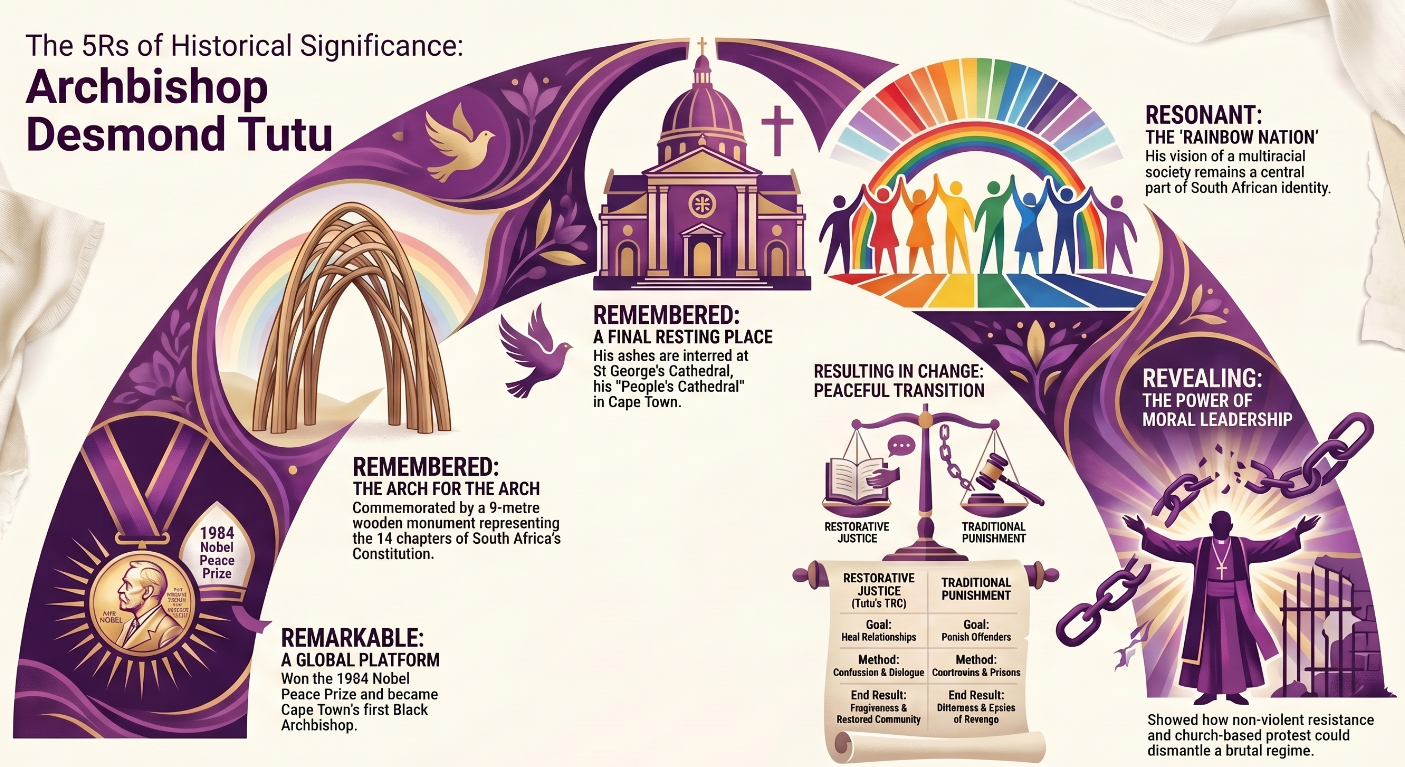
On 13 September 1989, he led the Cape Town Defiance March of 30,000 people from the cathedral steps to City Hall, where he addressed the crowd from the balcony and called South Africans "the rainbow people of God" - the phrase that later became "Rainbow Nation."
Nobel Peace Prize
Second, his Nobel Peace Prize in 1984 brought international attention to apartheid at a crucial moment. The award gave him a global platform he used to push for sanctions.
From his residence at Bishopscourt (a house in a historically White-only neighbourhood where, under apartheid, a Black family wouldn't even have been allowed to visit without permits) he met with foreign diplomats to coordinate the international pressure.
When Mandela was released from prison on 11 February 1990, his very first night of freedom in 27 years was spent at Bishopscourt with the Tutus, which shows just how central Tutu had become to the transition.
Truth and Reconciliation Commission
Thirdly, after apartheid ended, Tutu chaired the Truth and Reconciliation Commission, which was a brand new way of dealing with the crimes of a violent past.
Instead of putting everyone on trial, the TRC let victims tell their stories publicly and offered amnesty to people who confessed honestly.
Many of its most important hearings were held in Cape Town, and the model has since been studied and adapted by other countries recovering from conflict, including Rwanda and Northern Ireland.
Today, the Desmond and Leah Tutu Legacy Foundation, run from the Old Granary on Buitenkant Street - a building that used to be a colonial-era women's prison - keeps that work alive.
Tutu liked that a place built for cruelty had been turned into a place for repair.
Legacy - Ties to Cape Town
His legacy is so tied to Cape Town that when he died on 26 December 2021, his funeral was held at St George's Cathedral and his ashes were interred there - back where the story really began.
Just outside the cathedral stands "The Arch for the Arch", a wooden archway unveiled on his 86th birthday in 2017, made of 14 timber strips that each represent a chapter of South Africa's Constitution.
Most heroes get a statue you look up at. Tutu got an arch you walk through.
My Mom says it is fitting as even his monument refuses to put him on a pedestal, which says a lot about the kind of person he was.
Humble, yet powerful. Charismatic, lovable and an absolute legend of a man that changed our country's history forever.